· 8 min read · Maus Team and Maus Team
Cue by Manus alternative: open source, no invite code
Cue by Manus gives each agent its own phone, email, wallet, and computer, behind an invite code. Maus is the open-source take: your agents, your machine.
Maus is the open-source alternative to Cue by Manus. Cue is the same idea, several personal agents that each get their own computer and work together in one chat, but it is closed, invite-only, runs in Manus's cloud on an undisclosed model, and keeps your data under Manus's terms. Maus is free, Apache 2.0 licensed, runs on your own machine, and uses the Claude, Codex, and Grok subscriptions you already pay for. There is no invite code.
What is Cue by Manus?
Cue launched on September 28, 2026, the same day as Manus 2.0. Where Manus is the workspace you open to research and build, Cue is the app for the rest of your life: "your personal agents, with their own identity." Each agent gets its own email address, its own phone number, a wallet with a budget you set, and a computer in Manus's cloud. It can take your calls while you are in meetings, message people from its own number, pay for things inside its budget, and see a task through on its own machine.
- Web, macOS on Apple Silicon, and Android; iOS is in App Store review and Windows is marked coming soon.
- Early access with an invite code. The launch code was reported to be capped at 1,000 users, and members get codes to share.
- Free for now. The Play listing says a Plus membership is included at no charge once you are in, which suggests a paid tier later.
- Agents collaborate in a group conversation, run automations on a schedule or an event, and remember your preferences per agent.
- Scan a QR code at a cafe and an agent reads the menu and orders; you confirm the payment.
- Made by Butterfly Effect Pte. Ltd. in Singapore. Tencent is the largest outside shareholder after Meta's $2 billion purchase was blocked by China's NDRC in April.
Why people look for a Cue alternative on day one
- You cannot get in. One code and a reported cap of 1,000. Most people who read the launch post will not have an agent by tonight.
- Whose cloud, whose model. Cue does not say which model runs your agents, and every one of them lives on a computer in Manus's cloud. If you already pay for Claude, Codex, or Grok, none of that is used.
- The data question. Cue runs under Manus's privacy terms. A third-party audit in August graded Manus a B: data in the US and Singapore, a training opt-out that is off by default, retention for conversation logs unspecified. In the same month Manus deleted data generated since December 29, 2025 for users in unnamed jurisdictions. An agent with your email, your phone, and a wallet is a lot to hand to a company that changed hands twice in the last nine months.
- Credits. Cue's price is not published, but Manus bills in credits, and a common Manus complaint is credits burning fast, including on failed tasks, with the cost invisible until afterwards. Cue has not said whether Plus will bill the same way.
- Closed source. Nothing to read, nothing to self-host, nothing to run air-gapped.
What is Maus?
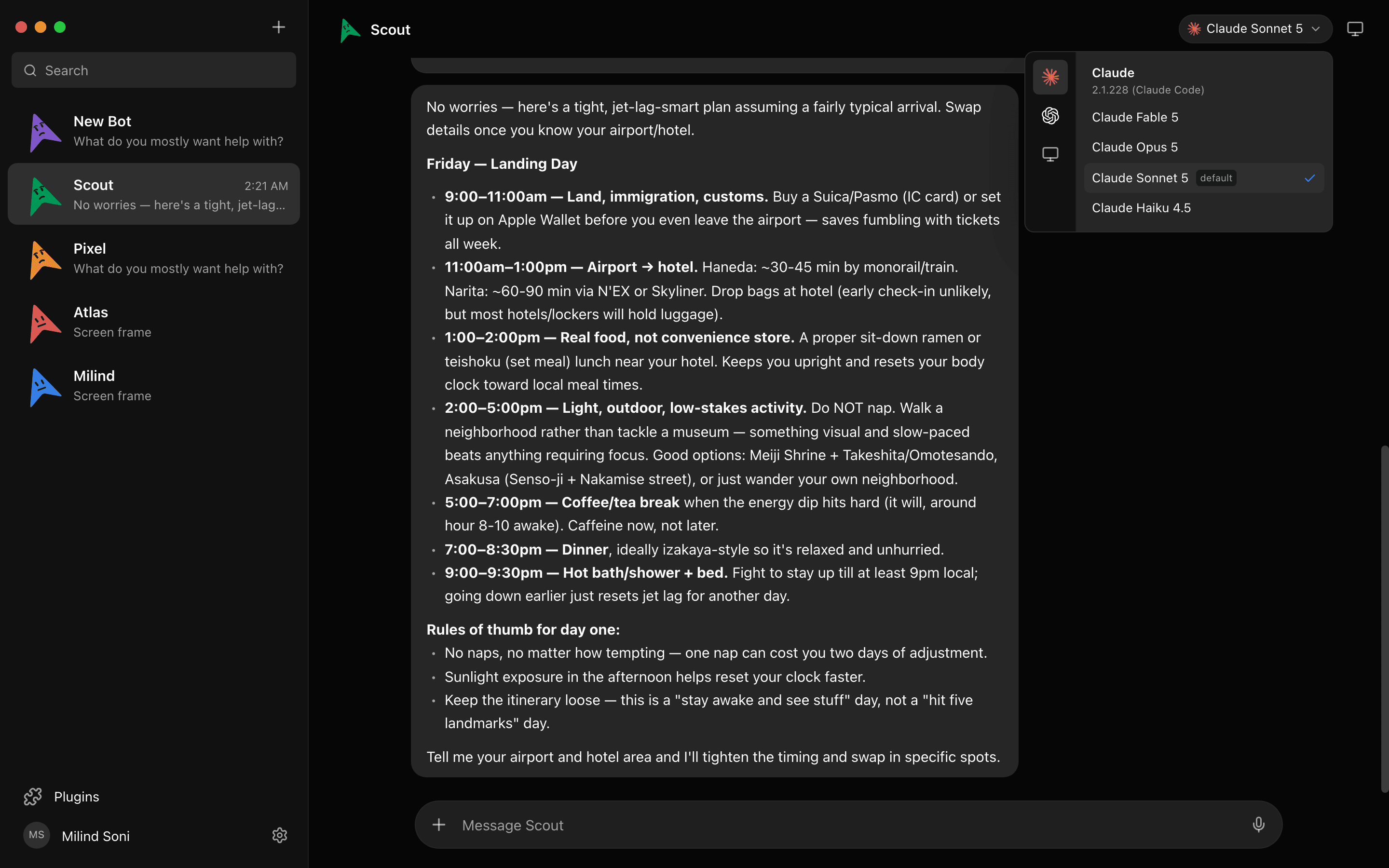
Maus has the same shape as Cue and has had it since August. It is a chat app where every contact is a bot with its own model, its own computer, and its own connected apps, and bots can share a room. The difference is everything underneath. Each bot runs on the claude, codex, or grok CLI installed on your computer, with your existing login. A small harness on 127.0.0.1 owns every agent process, and your data stays in ~/.maus. The code is on GitHub under Apache 2.0.
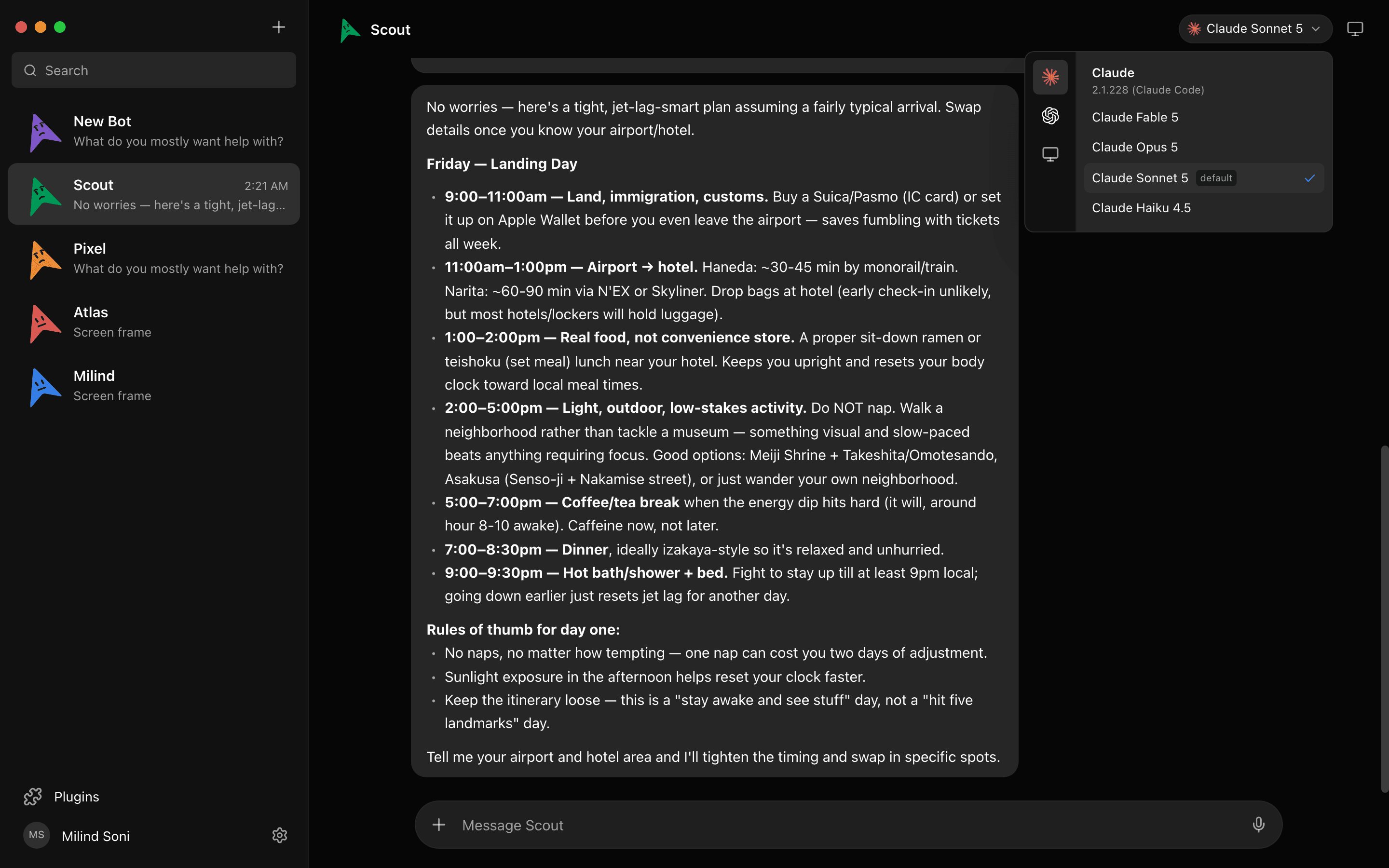
Try it. This is a live simulation of four bots working in parallel:
A simulation. Pick a bot, or type to it. The replies are scripted; the real thing runs on your own machine.
Cue by Manus vs Maus
Cue's column comes from cue.im, the Manus 2.0 launch post, and the Google Play listing on launch day. Where Manus has not said, the cell says so.
| Cue by Manus | Maus | |
|---|---|---|
| How you get in | Invite code, early access; the launch code was reported capped at 1,000 users | Download. No invite, no waitlist. |
| Price | Free during early access; a Plus membership is mentioned, price not published | Free. You pay your model providers directly. |
| License | Proprietary | Apache 2.0, app and harness |
| Models | Not disclosed; Chinese coverage reports the same infrastructure as Manus 2.0 | Claude, Codex, and Grok, chosen per bot, plus Cursor, Kimi, OpenCode, Qwen, and other CLIs |
| Where the agent runs | Manus's cloud; each agent gets its own computer there | Your machine, on the CLIs you already have; or a cloud desktop per bot |
| Where your data lives | Manus servers in the US and Singapore, under Manus's privacy terms | ~/.maus on your disk |
| Training on your data | Opt-out exists in Manus settings and is off by default, per a third-party audit | Never. There is no server to train from. |
| How many agents | Several, each with its own identity and memory | As many bots as you like, each with its own model, computer, and apps |
| Agents in one conversation | Yes, group collaboration | Yes: group rooms with @mentions, hand-offs, and group calls |
| Before it acts | You set review boundaries; it brings work back when a decision needs you | Allow / Deny card for every shell command, file edit, and question |
| Own phone number, email, wallet per agent | Yes | No |
| Connected apps | Gmail, Trip.com, Oura, MyFitnessPal, YouTube, Instagram, LinkedIn, and more | 500+ apps over Composio, OAuth once |
| Automations | Yes, on a schedule or an event | Yes, on a schedule or from a webhook |
| Keeps working with your laptop closed | Runs in Manus's cloud, so automations and calls do not depend on your device | Only for bots on a cloud computer |
| Platforms | Web, macOS (Apple Silicon), Android; iOS in review; Windows coming soon | macOS, Windows, Ubuntu; iOS and Android companions |
| Self-host or air-gap | No | Yes |
What Maus does
A team of agents, in rooms
This is the part Cue and Maus agree on. Put bots in a group room; one answers by default, or everyone does, or only the ones you @mention. Bots ask each other questions and hand off work, a peer-comms approval card lets you decide who talks to whom, and the whole room can join a call. Export the team for someone else to import.
Your models, not an undisclosed one
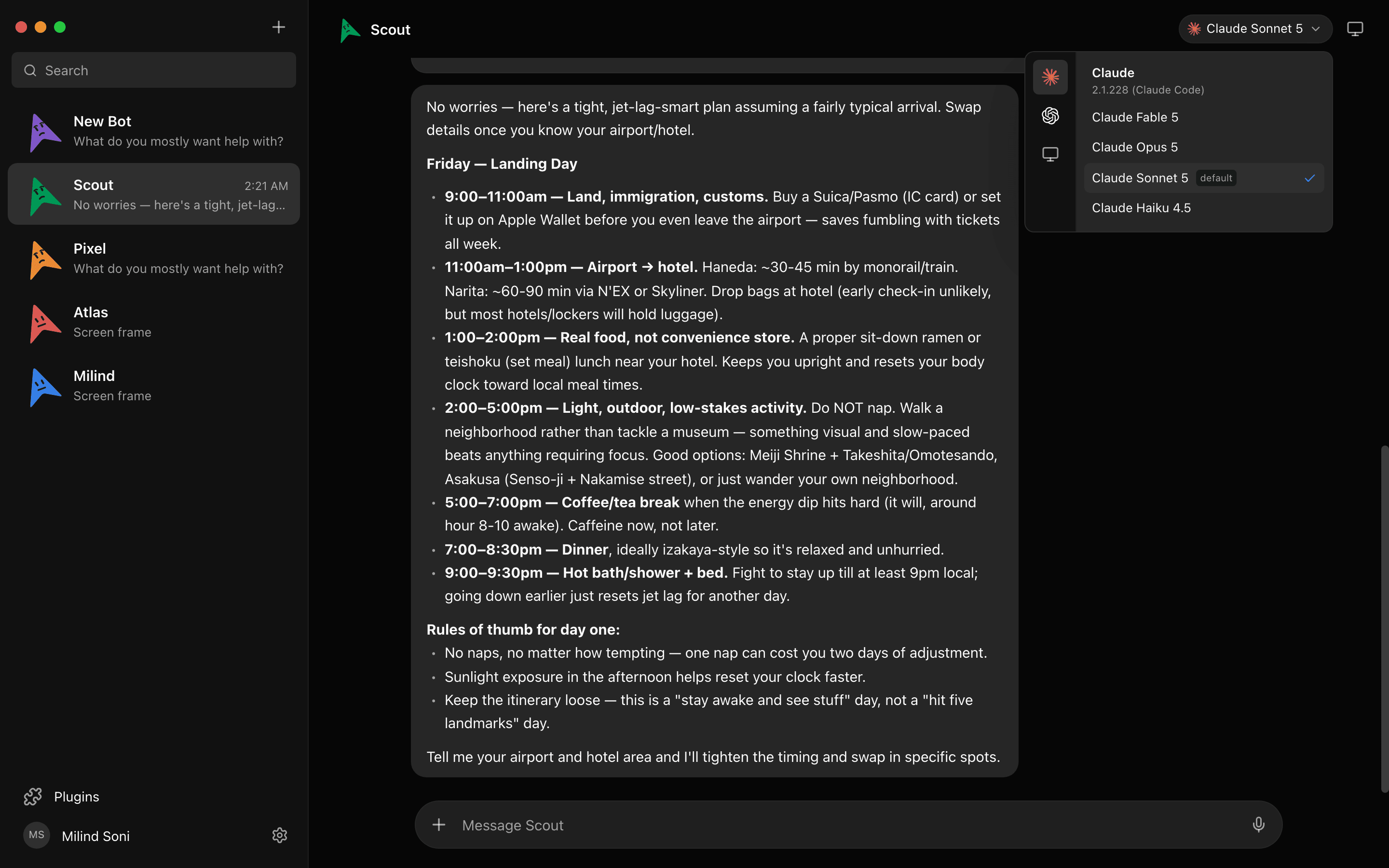
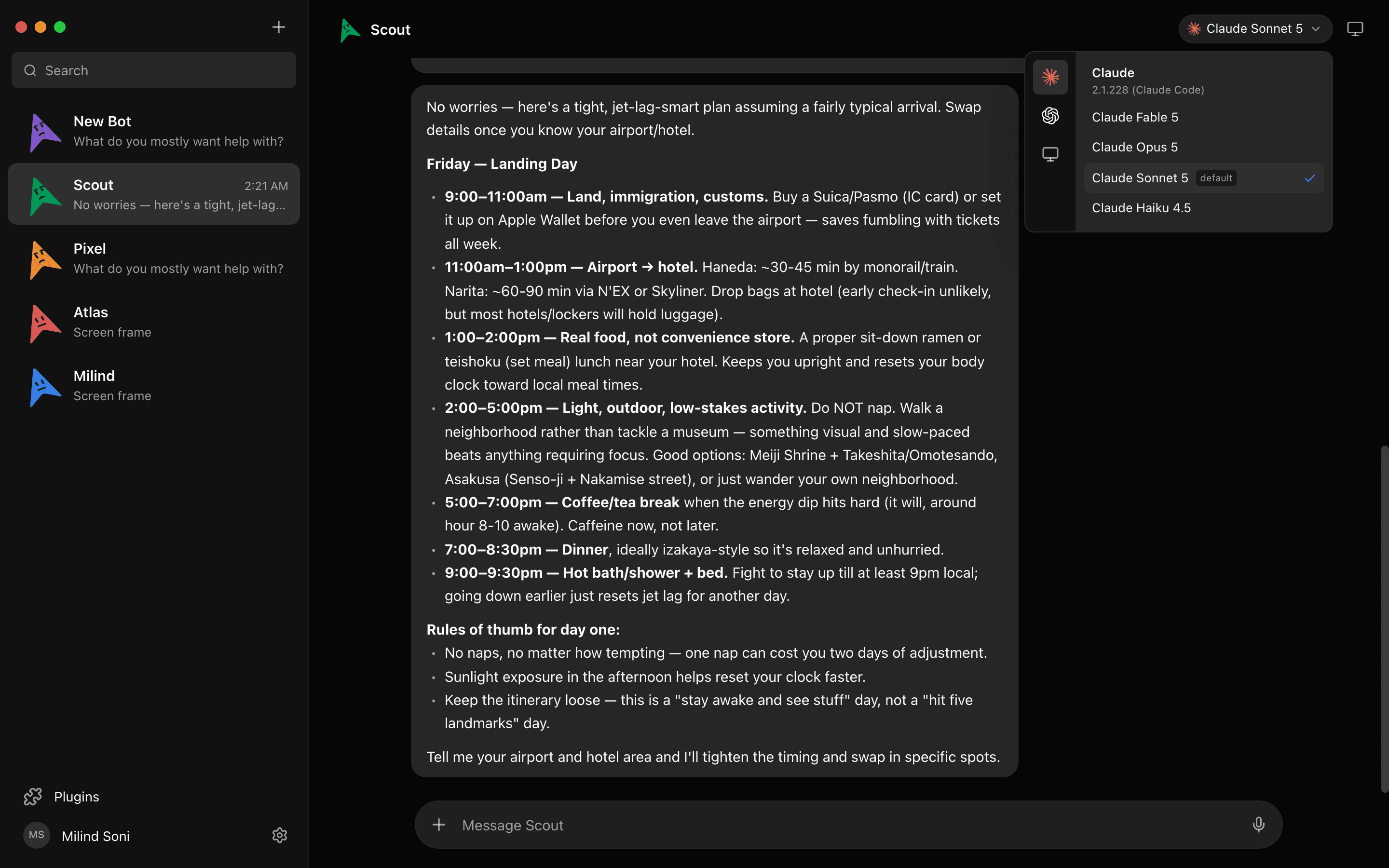
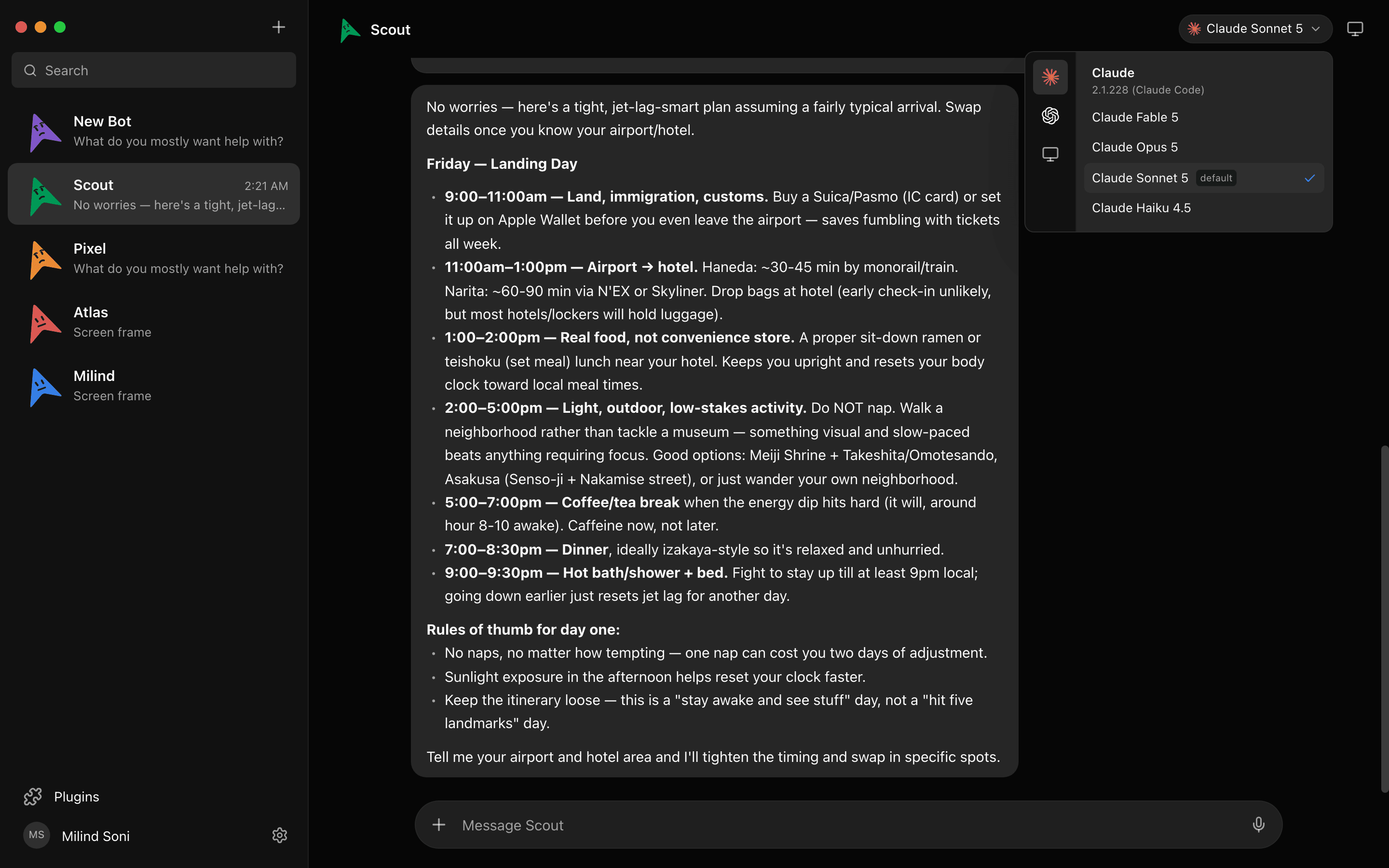
Cue does not say what runs your agents. Maus runs whichever agent you already pay for. Claude, Codex, and Grok sit side by side in a provider rail, and the engine list also covers Cursor, Kimi, OpenCode, and Qwen. Give one bot Claude for writing and another Codex for code, and switch mid-conversation.
A computer per bot, yours or a cloud one
Cue gives every agent a computer in Manus's cloud. Maus gives every bot a choice: open the Computer panel and a cloud desktop spins up with a live preview and a take-over button, or point the bot at your own machine and it browses as you, with your sessions, from your IP.

Bots ask before they act
Cue says you set the review boundaries and the agent brings work back when a decision needs you. Maus draws the line at every risky action: shell commands, file edits, and questions surface as cards in the chat, and nothing runs until you answer. The decision log is yours to read.
Connected apps
Gmail, Slack, GitHub, Notion, Linear, and hundreds more over Composio. OAuth once, and every bot can use them as tools. The tokens live on your disk, not in a cloud that a data-retention policy applies to.
Bots that talk back
Press the speaker on any reply, or hit call and have a conversation. The bot hears you, narrates its work, and asks for approvals out loud. Bring your own ElevenLabs key.
What Cue does that Maus does not
Four things, and they are the reason Cue exists. Each Cue agent has its own phone number and can answer your calls and call people back; Maus bots call you inside the app, not third parties. Each Cue agent has its own email address and a wallet with a spending limit; Maus bots use your accounts over OAuth and have no money. Cue can order from a restaurant's QR code. And Cue agents run in Manus's cloud, so nothing depends on your device being awake; Maus only does that for bots you have put on a cloud computer. If any of those is the job, Cue is the better tool, once you have a code.
Which one should you choose?
Choose Cue if you have an invite, you want agents that can phone, pay, and email as themselves, you need them running with your phone in your pocket, and you are comfortable with your agents' inboxes and wallets living on Manus's servers.
Choose Maus if you want the same team-of-agents shape today, you already pay for Claude, Codex, or Grok, you want a different model per bot, you need your data on your own machine, or you have a security review to pass. It is also the one you can read before you run it. For the other closed agents in this category, see our posts on Meta Muse, Grok Bot, and Instinct.
Frequently asked questions
- What is Cue by Manus?
- Cue is a consumer app from Manus (Butterfly Effect Pte. Ltd., Singapore) launched on September 28, 2026 alongside Manus 2.0. You get several personal agents, each with its own identity: an email address, a phone number, a wallet with a budget you set, and a computer in Manus's cloud. They can take your calls, order from a QR code at a restaurant, run automations, and work together in one conversation. It is not the Cue meeting-notes app or the heycue.io desktop assistant, which share the name.
- How do I get a Cue invite code?
- Cue launched in early access with a launch code, MEETCUE, that Chinese press reported was capped at 1,000 users; accepted users get codes to share. Maus has no invite. Download it and it runs.
- Is Cue by Manus free?
- Free during early access, and the Play Store listing says a Plus membership is included at no charge once you are in, which points to a paid tier later. No price is published. Maus is free and open source; you only pay the model providers you already use.
- Is Cue open source? Is there an open-source alternative to Manus?
- Cue is not open source, and neither is Manus. The closest open-source thing to Cue's shape, several agents that each get a computer and work together, is Maus, which is Apache 2.0 licensed. For the Manus research-and-build workspace, OpenManus on GitHub is the well-known clone.
- Where does my Cue data go?
- Cue runs under Manus's privacy policy. A third-party audit in August 2026 found data stored in the US and Singapore, a training opt-out that is off by default, and an unspecified retention period for conversation logs. In August, Manus deleted data generated since December 29, 2025 for users in unnamed jurisdictions. Maus keeps everything in ~/.maus on your own disk.
- Is Maus affiliated with Manus?
- No. It is an independent open-source project. Manus and Cue are products of Butterfly Effect Pte. Ltd., and Maus is launching its own $MAUS token on Solana soon.
Get started in two minutes
The harness is embedded, so there is nothing else to install. Download for macOS, Windows, or Ubuntu, sign in with the CLIs you already have, and meet your first bot. No invite code, no card, no credits. Or read the source on first. Everything on the features list is free, forever.