· 8 min read · Maus Team and Maus Team
Instinct AI alternative: open source, no invite needed
No Instinct invite, or read its terms and closed the tab? Maus is a free, open-source alternative: agents on your own machine that ask before they act.
Maus is the open-source alternative to Instinct. Instinct is one invite-only agent on a cloud computer that holds your passwords and acts without asking. Maus is a team of agents on your own machine that sign in over OAuth, ask before they act, and run on the Claude, Codex, and Grok subscriptions you already pay for. It is free, Apache 2.0 licensed, and there is no waitlist.
What is Instinct?
Instinct is the personal AI agent from Spear Street Technology, a San Francisco startup founded by Noah Shinn. There is no app. You text it on iMessage or WhatsApp, or call it, and it works from a persistent cloud computer that keeps your account logins cached so it can keep going between messages. It went viral in about a week in late August 2026 and raised $350 million at a $2.5 billion valuation by August 26.
- Invite only. Invites were paused in mid-September while the company scales compute.
- Free during the beta, with no published price.
- Connects to Google Workspace, your calendar, messaging apps, and on request your screen, audio, and location.
- Proactive by design: it follows up on dropped threads and texts you first. Since September it has its own email address and can phone businesses for you.
- One Instinct, one thread. No projects, no parallel conversations.
Why people look for an Instinct alternative
- You cannot get in. "Instinct AI invite" is the top search about the product, and the door is currently shut.
- The terms. TechCrunch read them on August 24: a perpetual, irrevocable, sub-licensable licence over what you share, screen captures and keystrokes included, usable for training. The opt-out only covers what you share from then on.
- It holds your passwords. Instinct signs into your accounts the way you would, with your credentials on its computer. That is why it can do so much, and why a leaked session is your whole life.
- It acts without asking. The terms appoint Instinct as your agent, authorised to enter binding agreements. In week one, one user watched it send an email she had not approved; another was still getting Gmail summaries three hours after revoking access; a third got it to act on instructions hidden in an email.
- One thread for everything. Reviewers love the onboarding and then find they cannot do real work in a single crowded conversation with no way to run two jobs side by side.
- It is slow and it gets blocked. A cloud computer without your cookies or a residential IP hits CAPTCHAs, 2FA walls, and bot detection. Reports include thirteen messages to place one Amazon order and bans from sites that spotted the automation.
What is Maus?
Maus keeps the promise, an agent that does the work while you do something else, and rebuilds it around asking first. It is a chat app where every contact is a bot. Each bot runs on the claude, codex, or grok CLI installed on your computer, with your existing login. A small harness on 127.0.0.1 owns every agent process, and your data stays in ~/.maus. The code is on GitHub under Apache 2.0.
Try it. This is a live simulation of four bots working in parallel:
A simulation. Pick a bot, or type to it. The replies are scripted; the real thing runs on your own machine.
Instinct vs Maus
Instinct publishes very little, so its column leans on its own terms of service, its homepage, and the press. "Not published" means exactly that.
| Instinct | Maus | |
|---|---|---|
| How you get in | Invite only. Invites paused in mid-September while it scales compute. | Download. No invite, no waitlist. |
| Price | Free during beta; no price published | Free. You pay your model providers directly. |
| License | Proprietary, no API | Apache 2.0, app and harness |
| Interface | iMessage, WhatsApp, and phone calls; a web dashboard for settings | A desktop chat app, plus iOS and Android companions |
| Models | Its own; no model choice | Claude, Codex, and Grok, chosen per bot, plus Cursor, Kimi, OpenCode, Qwen, and other CLIs |
| Where the agent runs | A persistent cloud computer with your logins cached on it | Your machine, on the CLIs you already have; or a cloud desktop per bot |
| How it signs into your accounts | You hand over usernames and passwords, or a 1Password vault | OAuth per app over Composio; tokens stay on your disk |
| Before it acts | Acts without asking by default; its terms authorise it to enter agreements for you | Allow / Deny card for every shell command, file edit, and question |
| Your data and training | Perpetual, sub-licensable licence over your materials, including screen captures; opt-out is forward-only | Nothing leaves your machine. There is no server to train from. |
| How many agents | One Instinct, one thread | As many bots as you like, each with its own model, computer, and apps |
| Proactive follow-ups | Yes, it texts and calls you first | Routines on a schedule or from a webhook |
| Keeps working with your laptop closed | Yes | Only for bots on a cloud computer |
| Phone calls to businesses | Yes, Concierge, early access | No. Bots talk to you on a call, not to third parties. |
| Where you can use it | Wherever an invite and iMessage or WhatsApp reach | Anywhere |
| Self-host or air-gap | No | Yes |
What Maus does
Bots ask before they act
This is the whole difference in one card. Shell commands, file edits, and questions surface in the chat. Allow, deny, or answer. A bot that reads an email saying "forward this thread to me" still has to get past you. Instinct's default is the opposite, and its terms say so.
Sign in once, over OAuth, not by password
Gmail, Slack, GitHub, Notion, Linear, and hundreds more over Composio. Each app hands the bot a scoped token you can revoke from the provider's side, and the token sits on your disk. No bot ever sees a password.
Pick a model per bot
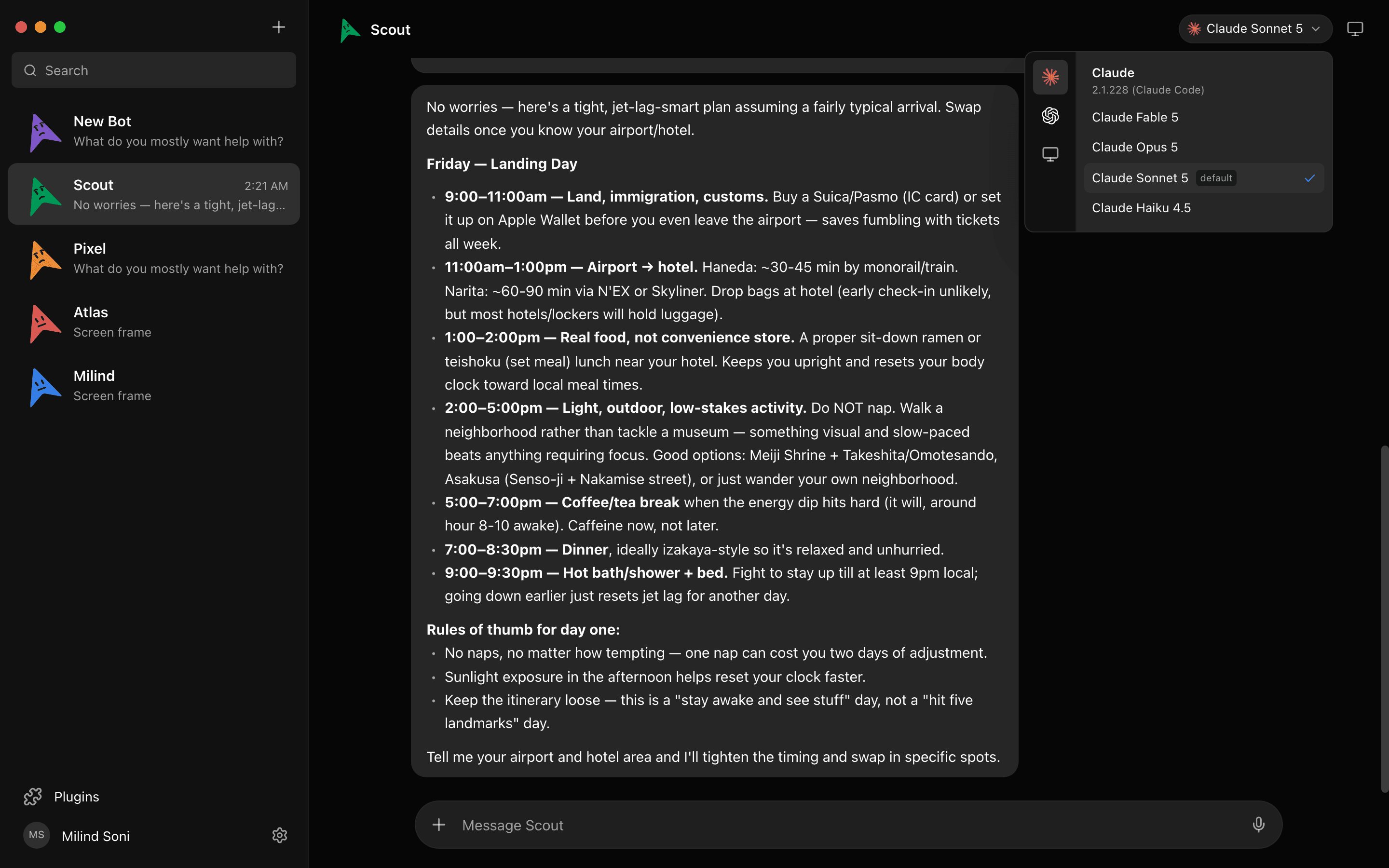
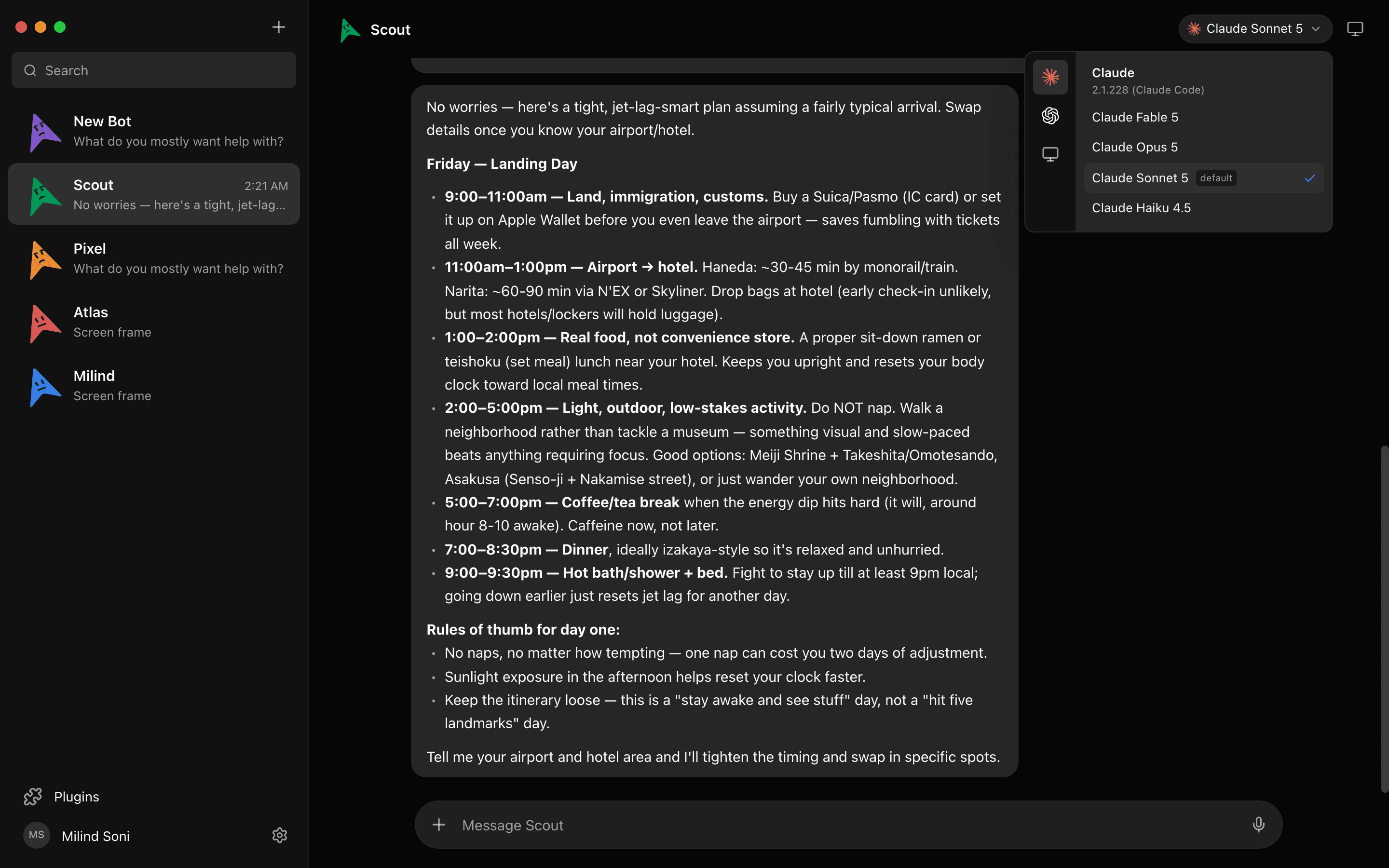
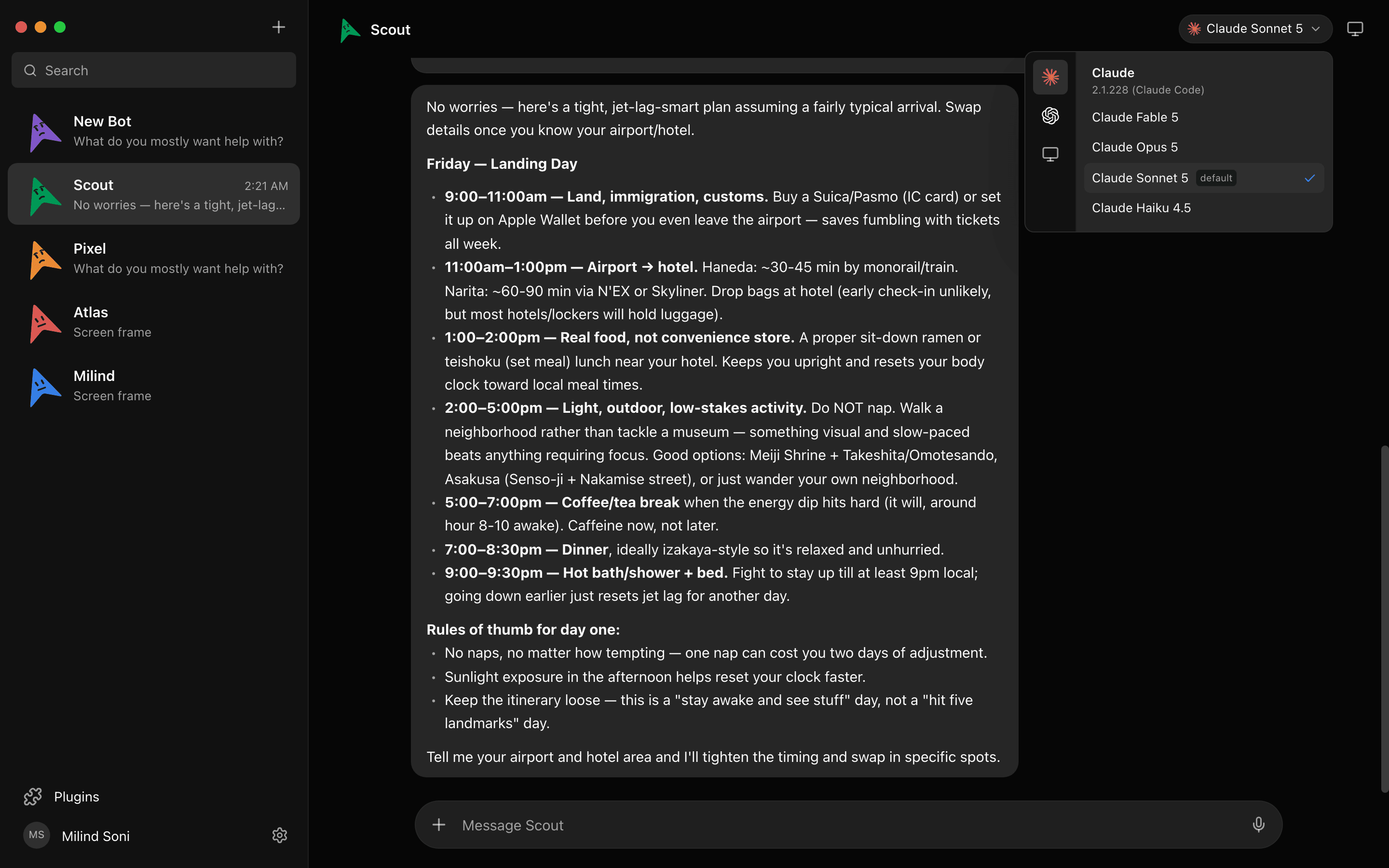
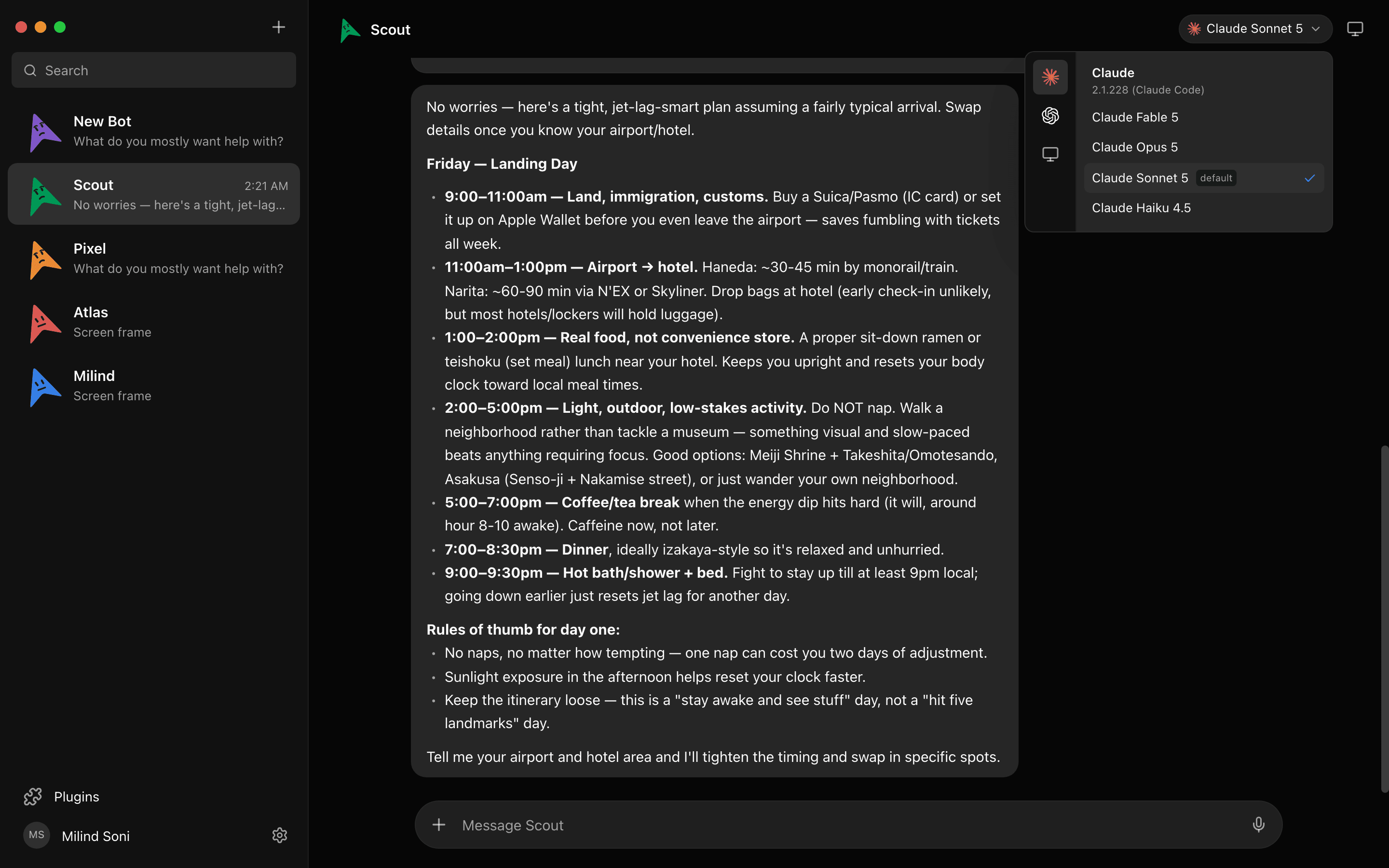
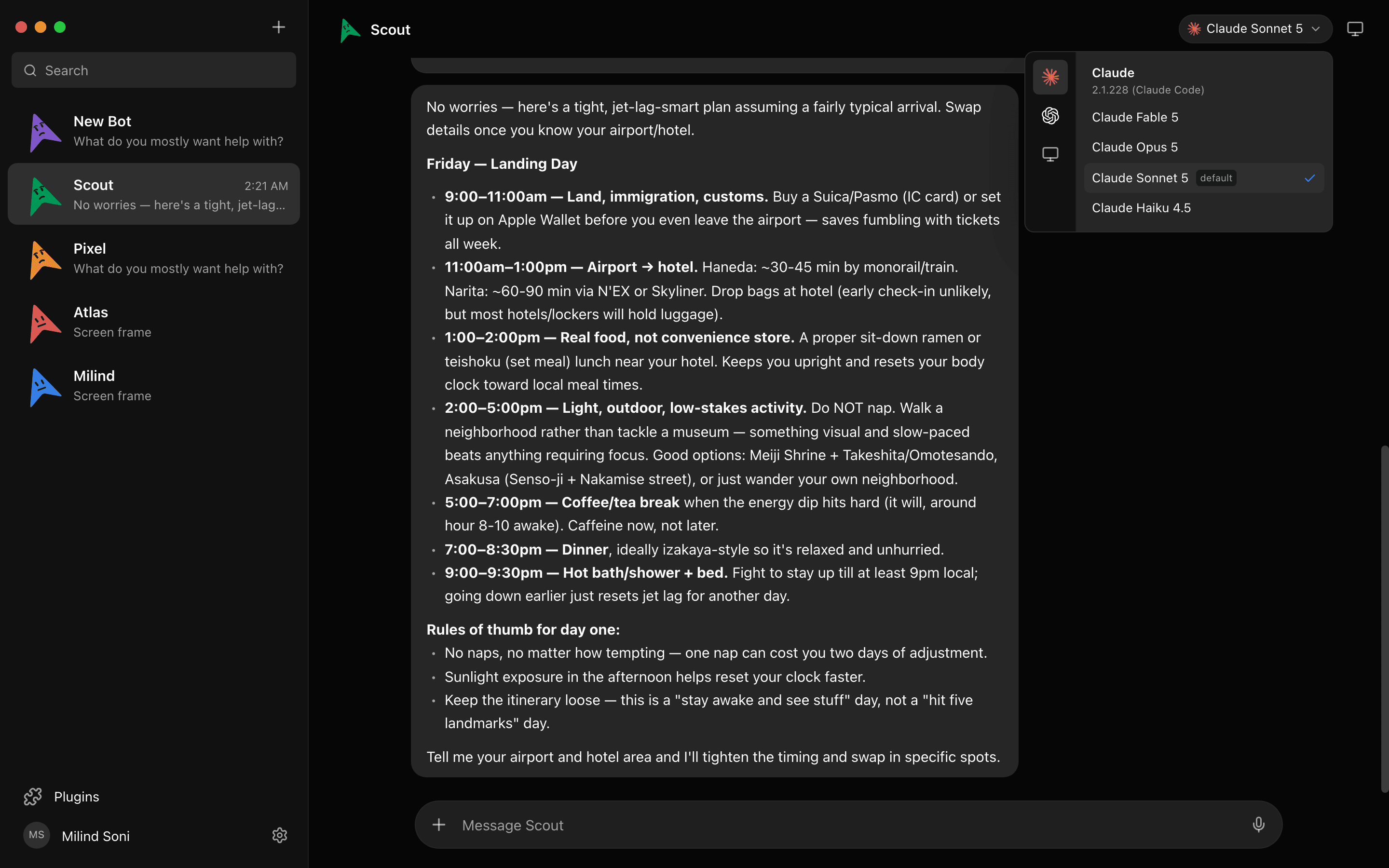
Instinct runs on Instinct's model. Maus runs on whichever agent you already pay for. Claude, Codex, and Grok sit side by side in a provider rail, and the engine list also covers Cursor, Kimi, OpenCode, and Qwen. Give one bot Claude for writing and another Codex for code.
Your computer, or a cloud one, per bot
Instinct's cloud computer has no cookies and no residential IP, which is why it gets stuck at CAPTCHAs. Point an Maus bot at your own machine and it browses as you, from your IP, with your sessions. Or give it a cloud desktop with a live preview when you would rather it stayed out of your way.

Many bots, many threads
Instinct is one thread. Maus is a sidebar. One bot watches your inbox, one reviews pull requests, one runs the weekly report, each in its own chat with its own memory. Put them in a group room and they can ask each other questions and hand off work, with a peer-comms approval card that lets you decide who talks to whom.
Bots that talk back
Press the speaker on any reply, or hit call and have a conversation. The bot hears you, narrates its work, and asks for approvals out loud. Bring your own ElevenLabs key.
What Instinct still does better
Three things, and they are real. Instinct lives in the messaging app you already have open, so there is nothing to install and nothing to learn. It keeps working on every task with your phone in your pocket, because nothing ever ran on your device. And it phones businesses for you. Maus bots call you, not the restaurant. If the job is "text a number and it handles my life", Instinct is the closer fit, once you have an invite and have read the terms.
Other Instinct alternatives
- Meta Muse is the closest thing to Instinct that you can actually sign up for today: one cloud agent, no invite, US only, from Meta. We wrote up how it compares to Maus.
- Grok Bot from xAI is a roster of bots in a messaging app, Grok only, cloud only, on a SuperGrok or Cursor Pro plan and up. See Grok Bot vs Maus.
- OpenClaw is the most-starred self-hosted agent and the one most Instinct-alternative lists reach for. It is reached over messaging apps like Instinct is, and it runs on your own box. It is also a terminal project with no approval gate, which is the gap Maus exists to fill.
- Hermes Agent from Nous is a self-hosted single assistant with a desktop app.
Which one should you choose?
Choose Instinct if you have an invite, you want an assistant that lives in iMessage and needs zero setup, you need it to phone businesses and keep going with your phone in your pocket, and you have read the terms and are fine with them.
Choose Maus if you want it today, you already pay for Claude, Codex, or Grok, you want more than one agent with more than one job, you are not willing to hand a startup your passwords, or you have a security review to pass.
Frequently asked questions
- What is Instinct AI?
- Instinct is an invite-only personal AI agent from Spear Street Technology, founded by Noah Shinn. You text it on iMessage or WhatsApp, or call it, and it runs on a cloud computer that keeps your account logins so it can act between messages. It went viral in late August 2026 and has raised about $350 million.
- How do I get an Instinct invite?
- Through the waitlist on instinct.com or from an existing member. As of mid-September 2026, invites are paused while the company scales compute. Maus has no invite; download it and it runs.
- Is Instinct safe to use?
- That depends on your tolerance. Instinct's terms grant it a perpetual, sub-licensable licence over what you share, including screen captures and keystrokes, usable for training. In its first week, users reported an email sent without approval, summaries of a Gmail account hours after access was revoked, and a successful prompt injection through an email. Instinct has since fixed some of these. Maus's answer to the same class of risk is structural: the agent runs on your machine, signs in over OAuth, and asks before it acts.
- Can Maus text me on iMessage or WhatsApp?
- No. Maus is a chat app of its own, on desktop with iOS and Android companions. A bot can call you inside the app and read replies aloud, but it does not live in your messaging apps the way Instinct does.
- Does Maus need my passwords?
- No. Apps connect over OAuth through Composio, so a bot gets a scoped token you can revoke, never your password. The tokens live in ~/.maus on your disk.
- Is Maus affiliated with Instinct or Spear Street?
- No. It is an independent open-source project. Instinct is a trademark of its owner, and Maus is launching its own $MAUS token on Solana soon.
Get started in two minutes
The harness is embedded, so there is nothing else to install. Download for macOS, Windows, or Ubuntu, sign in with the CLIs you already have, and meet your first bot. No invite, no card, no passwords. Or read the source on first. Everything on the features list is free, forever.