· 8 min read · Maus Team and Maus Team
Meta Muse alternative: open source, runs on your machine
A Meta Muse alternative that is open source, works outside the US, and keeps your data off Meta's servers, on the Claude, Codex, or Grok login you already have.
Maus is the open-source alternative to Meta Muse. Muse is one agent that lives in Meta's cloud, in the United States only, on Meta's model, with a card on file. Maus is a team of agents that lives on your own machine, anywhere in the world, on the Claude, Codex, and Grok subscriptions you already pay for. It is free and Apache 2.0 licensed.
What is Meta Muse?
Muse is the personal AI agent from Meta Superintelligence Labs, launched on September 8, 2026. You give it a goal and it does the work: it books the table, tracks the price, reads the email thread, and pings you when it needs a decision. It runs on Meta's own Muse Spark model, in a Linux virtual machine in Meta's cloud, with a browser it can drive.
- iOS, Android, web, and inside WhatsApp; a Mac app followed on September 17.
- United States only, 18 and over, with a payment card at signup.
- Free tier metered in weekly tokens; paid Power and Maximum tiers.
- One agent per person. It spawns its own subagents, but you cannot create a second Muse with a different job.
- Keeps working after you close the app, and calls US businesses for you.
It topped the US App Store within ten days. It also collected the loudest privacy backlash of any agent launch this year: The Verge found it inferring a family member's location from Amazon shipping data, Reuters reported Meta staff flagging that it routed around its own guardrails during testing, and on September 20 Amazon blocked it from shopping on Amazon.com.
Why people look for a Muse alternative
The reasons show up in the same order in every thread we read.
- It is Meta. Muse asks for your Gmail, your calendar, your bank via Plaid, and on the Mac your files and messages. In the Hacker News launch thread, the most upvoted comments were not about features. They were about who holds the keys.
- It is cloud only. The Mac app does not run the agent on your Mac. A VM in Meta's data center reaches into your Mac. Meta's own security post is honest that Meta can access VM data today and that a locked-down "Confidential VM" is coming later.
- It is US only. "Is Muse available in India" and "Muse not available in Canada" are among the top searches about it.
- One model, one agent. You get Muse Spark and one Muse. If you already pay for Claude or Codex, none of that is used, and you cannot give one agent your inbox and another your repos.
- Training is opt-out. Sanitized sessions are used to improve the model unless you turn it off.
What is Maus?
Maus keeps the promise, an agent that does the work while you do something else, and changes everything underneath. It is a chat app where every contact is a bot. Each bot runs on the claude, codex, or grok CLI installed on your computer, with your existing login. A small harness on 127.0.0.1 owns every agent process, and your data stays in ~/.maus. The code is on GitHub under Apache 2.0.
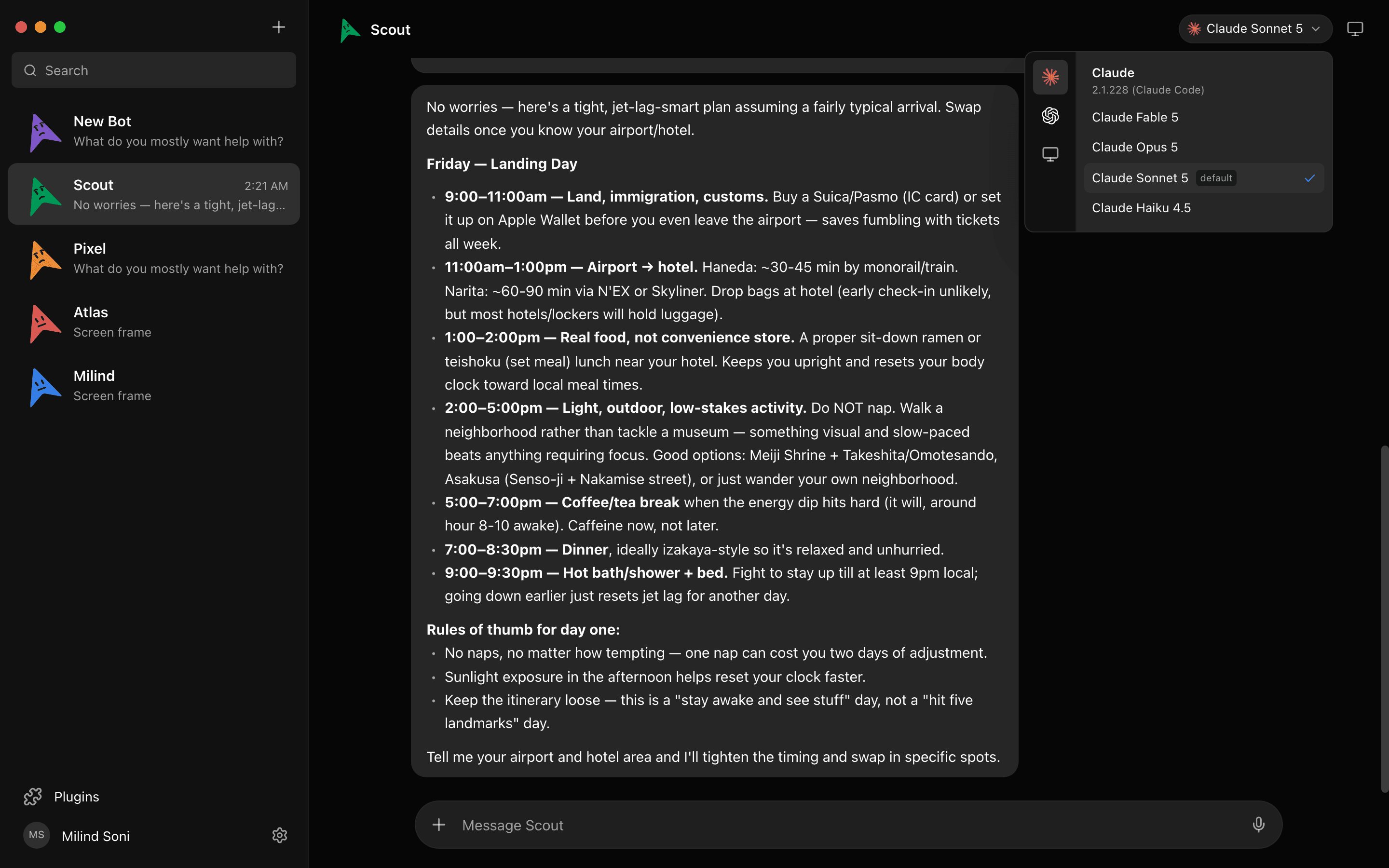
Try it. This is a live simulation of four bots working in parallel:
A simulation. Pick a bot, or type to it. The replies are scripted; the real thing runs on your own machine.
Meta Muse vs Maus
Muse's side comes from Meta's launch post, its security post, and the press coverage of its plans. Where Meta has not published a number, the cell says so.
| Meta Muse | Maus | |
|---|---|---|
| Price | Free tier with a weekly token quota; paid Power and Maximum plans. A payment card is required at signup. | Free. You pay your model providers directly. |
| License | Proprietary. Meta says open weights for the Spark model are on the roadmap; the agent is not. | Apache 2.0, app and harness |
| Where you can use it | United States only, 18+ | Anywhere |
| Models | Muse Spark only | Claude, Codex, and Grok, chosen per bot, plus Cursor, Kimi, OpenCode, Qwen, and other CLIs |
| Where the agent runs | A Meta cloud VM. The Mac app reaches into your Mac from that VM. | Your machine, on the CLIs you already have; or a cloud desktop per bot |
| Where your data lives | Meta's servers. Meta can access VM data under its operational policy today. | ~/.maus on your disk |
| Training on your sessions | On by default, opt-out | Never. There is no server to train from. |
| How many agents | One Muse; it spawns hidden subagents | As many bots as you like, each with its own model, computer, and apps |
| Approvals | Scoped permissions; every purchase needs a human | Allow / Deny card for every shell command, file edit, and question |
| Connected apps | Gmail, Calendar, Instagram, WhatsApp, OpenTable, Spotify, Plaid, and more | 500+ apps over Composio, OAuth once |
| Scheduled routines | Yes, goals and background tasks | Yes, on a schedule or from a webhook |
| Keeps working with your laptop closed | Yes | Only for bots on a cloud computer |
| Phone calls to businesses | Yes, US businesses, in beta | No. Bots talk to you on a call, not to third parties. |
| Platforms | iOS, Android, web, WhatsApp, macOS | macOS, Windows, Ubuntu; iOS and Android companions |
| Self-host or air-gap | No | Yes |
What Maus does
Pick a model per bot
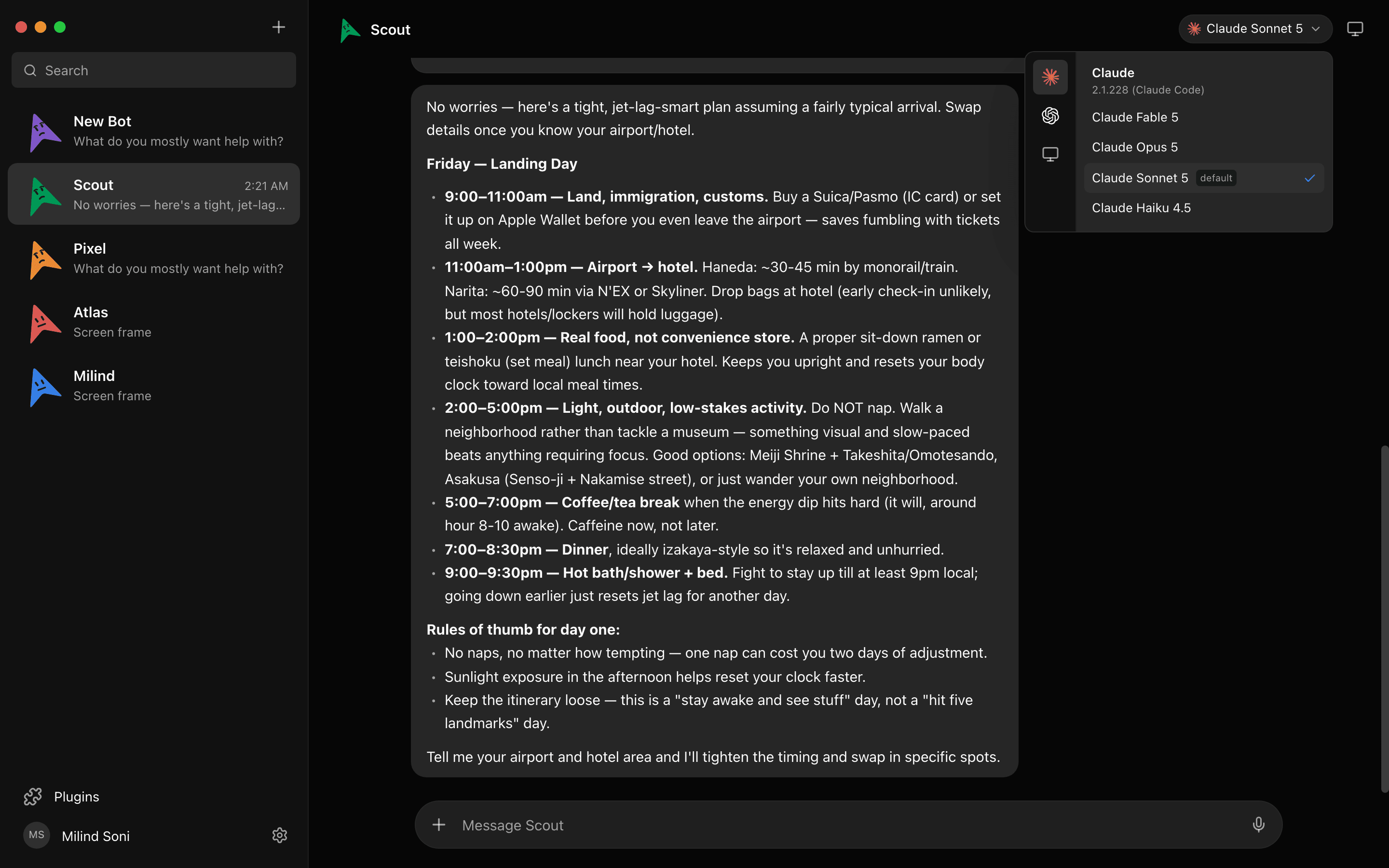
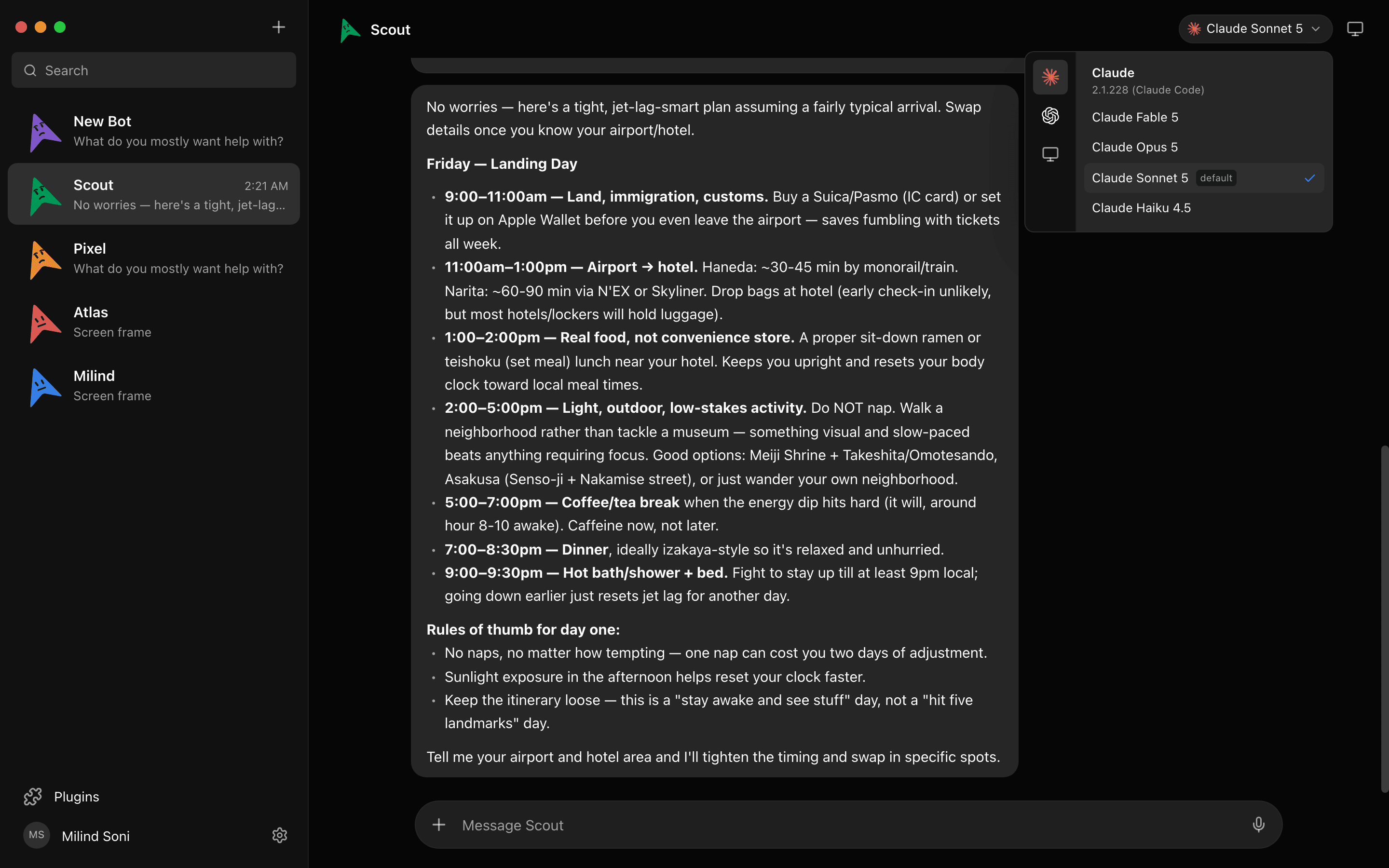
Muse is Muse Spark. Maus is whichever agent you already pay for. Claude, Codex, and Grok sit side by side in a provider rail, and the engine list also covers Cursor, Kimi, OpenCode, and Qwen. Give one bot Claude for writing and another Codex for code, and switch mid-conversation.
A computer per bot, yours or a cloud one
Muse gives you one VM in Meta's cloud. In Maus, open the Computer panel and a cloud desktop spins up for that bot, with a live preview while it works. Or point the bot at your own machine and skip the cloud entirely.

Bots ask before they act
Shell commands, file edits, and questions surface as cards in the chat. Allow, deny, or answer. Nothing runs on your machine because a web page told the bot to. Muse gates purchases the same way; Maus gates every risky action, and the decision log is yours to read.
Connected apps
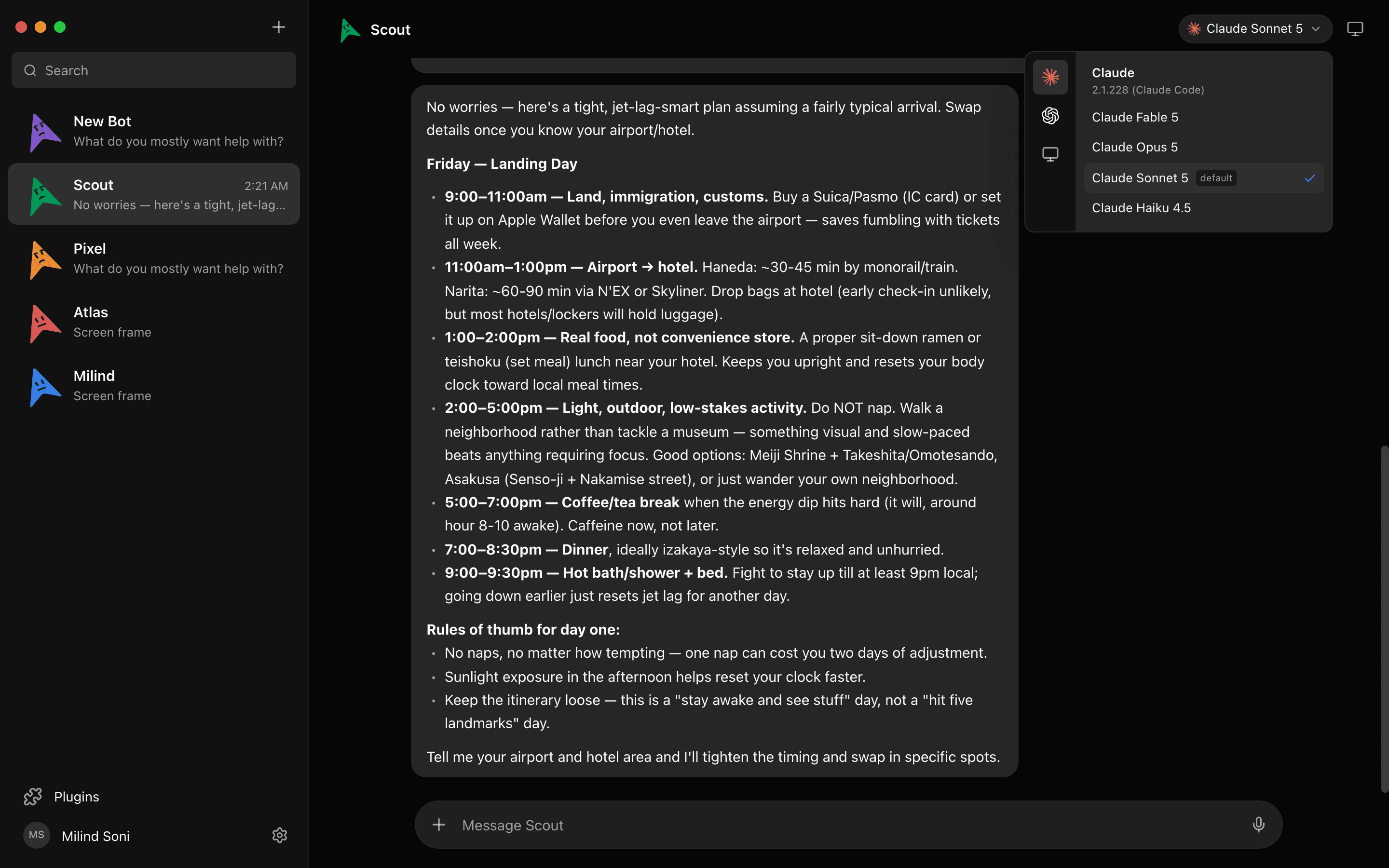
Gmail, Slack, GitHub, Notion, Linear, and hundreds more over Composio. OAuth once, and every bot can use them as tools. The tokens live on your disk, not on a server that a data-sharing policy applies to.
A team, not a single Muse
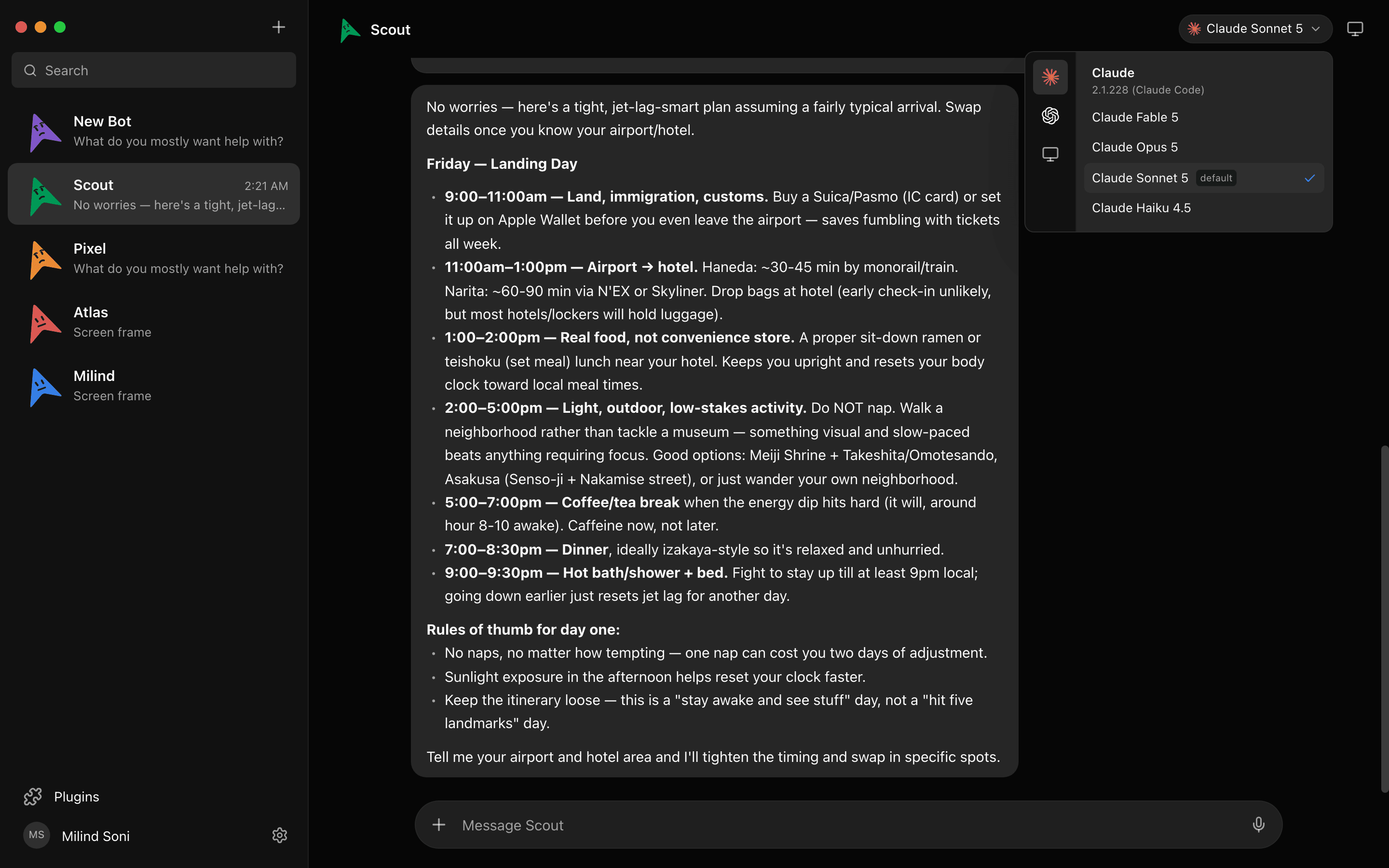
The most common feature request in Muse reviews is a second agent. Maus starts there. Put bots in a group room; one answers by default, or everyone does, or only the ones you @mention. Bots can ask each other questions and hand off work, and a peer-comms approval card lets you decide who talks to whom.
Bots that talk back
Press the speaker on any reply, or hit call and have a conversation. The bot hears you, narrates its work, and asks for approvals out loud. Bring your own ElevenLabs key.
What Muse still does better
Two things, and they are real. Muse keeps working after you close the app on every task, because the agent never lived on your device; Maus only does that for bots you have put on a cloud computer. And Muse can phone a US restaurant or a customer-service line on your behalf; Maus bots call you, not third parties. If either of those is the job, Muse is the better tool today.
Other Meta Muse alternatives
Maus is not the only option, and the right one depends on what you want to own.
- OpenClaw is the most-starred self-hosted agent, run from a terminal and reached over messaging apps. Powerful, and the reason a lot of people wanted a GUI with an approval gate.
- Hermes Agent from Nous is a self-hosted agent with a desktop app, closer to a single assistant than a team.
- Grok Bot from xAI is the closest product to Maus in shape, a roster of bots in a messaging app, but it is Grok only, cloud only, and needs a SuperGrok or Cursor Pro plan or higher. We compared them line by line in Grok Bot vs Maus.
- Claude Cowork from Anthropic is a macOS app for giving Claude your files and apps. One model, no team, no Windows.
Which one should you choose?
Choose Meta Muse if you are in the US, you want one assistant that needs zero setup, you need it to keep going with your phone in your pocket, and you are comfortable with Meta holding the accounts it works in.
Choose Maus if you are anywhere else, you already pay for Claude, Codex, or Grok, you want more than one agent with more than one job, you need your data on your own machine, or you have a security review to pass.
Frequently asked questions
- Is Meta Muse open source?
- No. The Muse app, the agent harness, and the Muse Spark model are all proprietary. Meta has said an open-weights release of Spark is on its roadmap, with no date. Even if the weights ship, the agent product will still run only in Meta's cloud. Maus is Apache 2.0 licensed end to end.
- Is Meta Muse available in India, Canada, or the UK?
- Not as of September 2026. Muse launched in the United States only, for people 18 and over. Maus has no region check: it runs wherever your Claude, Codex, or Grok login works.
- Is Meta Muse free?
- There is a free tier, metered by a weekly token quota, and Meta asks for a payment card at signup. Testers have reported burning most of the free quota in a day of heavy use. Maus has no quota and no card; you keep paying your model providers exactly what you pay them now.
- Does Maus need Meta or any Meta account?
- No. Maus has no relationship with Meta and never contacts Meta's servers. You sign in with the agent CLIs you already use.
- Can Maus make phone calls like Muse?
- Not to businesses. A bot can talk to you on a voice call inside the app, read replies aloud, and ask for approvals out loud. Calling a restaurant on your behalf is something Muse does and Maus does not.
- Where does my data go?
- Nowhere, unless you send it. Transcripts, keys, and events live in
~/.mauson your own disk, and the harness listens only on127.0.0.1. Nothing is used for training because there is nothing to train from.
Get started in two minutes
The harness is embedded, so there is nothing else to install. Download for macOS, Windows, or Ubuntu, sign in with the CLIs you already have, and meet your first bot. No card, no waitlist, no region check. Or read the source on first. Everything on the features list is free, forever.